
By Remi Terhorst
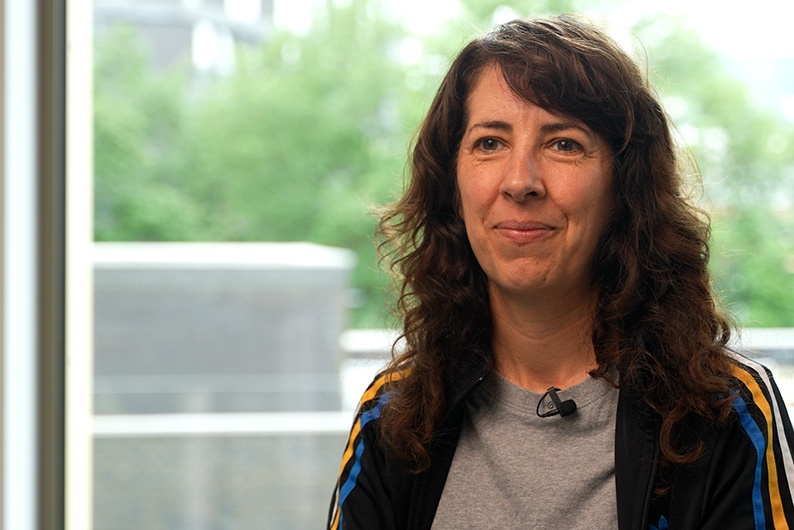
How can kids learn about ecosystems through play? And why is it so important to actively involve children throughout your research when you design for them? We talked about it with Saumya Grover, designer in Sustainable Innovations and academic fellow at BITS Design School in Mumbai. She and fellow designer Hüma Sabirli developed a physical game (Growing Minds) for children to teach them about sustainability, and involved school kids in both research and play-testing to improve the design.
Growing Minds
Saumya, who wrote her thesis about children’s learning through play, combined this topic with sustainable design; to raise children’s ecological awareness and skills in a fun and playful way. “We focused on the early years of education, because that’s when children build habits and cognitive skills. If you want to help them build a sustainable lifestyle, that is the age group you want to start.” She soon found out in her primary and secondary research that it is not easy to integrate sustainability into educational programs of schools. “The actors in the school systems that we used for our field research did not understand the importance of sustainable education, their current education system was not designed for holistic learning and they lacked a lot of teacher training on this subject. We then decided to build a physical educational game, because the children need something that makes them move, think and actually do something. This type of learning is called physical literacy and it is especially important during early childhood. That’s how Growing Minds started.”
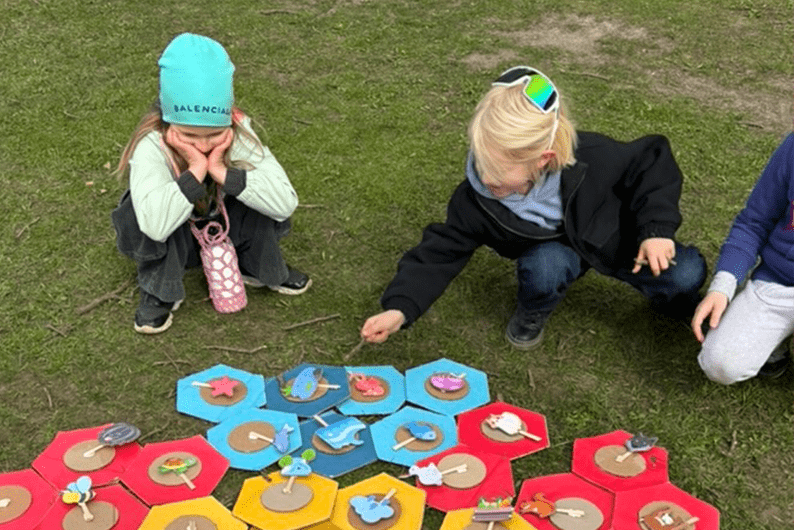
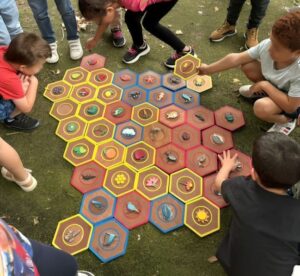
The game is designed for children from six to eight years old and teaches these kids skills that are essential for sustainable development; systems thinking, problem solving, adaptability and collaboration. The game consists of hexagon tiles and different icons, based on the environmental elements (flowers, animals, etc.). Children can move these tiles and icons around, create their own ecosystem and learn how these icons relate to each other.
Involving kids in design
As part of her thesis, Saumya used case studies from schools around the world that were looking at alternative pedagogy and curriculum. “Later in the process, we also visited some (green) schools, where we interacted with the children. But the main focus there was observing the school, to understand how classes are run, how they interact with each other and what their attitude towards our project was.
While working with children was both important and fun, Saumya encountered several difficulties during the project. “Especially before we had the prototype, the kids we interacted with were mostly reluctant to take initiative. They would be looking up to their teacher and were waiting to be told exactly what to do, because that is how their (and most) school system works; they go to class, sit down and wait to get told what needs to be done. This results in children not thinking independently. With Growing Minds, we want to encourage children to think outside the box and be creative, because that age group needs imagination the most.”
The first time we actively involved the school children in the design process was before we even had a prototype for the game. We did plan some activities for them, for example a card game about storytelling, where they were given two cards with a certain relation to each other. Based on those two cards, the children had to guess what a third card should be. By connecting cards that way, they created story sequences and learned about relations between the cards. “This was really interesting, because we learned where they stand in such activities, and how they think.”
“Then we started designing the game. For our first design, we used images that you could move around on different tiles. It didn’t work: The kids thought that they needed to match the colors ofthe tiles and match the images. They took all the animal images and put them on one side, and did the same with all the fruit images. We then took a lot of the feedback, went back to the drawing board and changed our prototype. We changed the images to icons, which made a lot more sense to the kids. For example, they started to put the icon of an apple together with the icon of a tree.”
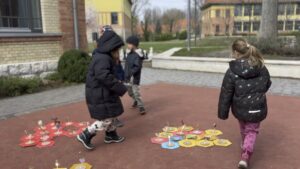
At the beginning of playtesting, Saumya and Hüma also discovered that the size of the focus group is very important. “At our first playtest, we had twenty children playing the game at the same time, which was very chaotic. We decided to bring the groups back to four kids at a time and noticed that it had a positive effect on both collaboration and interaction with the game. After making the final prototype based on the feedback of the children and schools, we tracked the impact the game had on the children by returning every few days or weeks to the same set of children. We could see the progress in their behavior and response to the game.”
The future
As a designer, it is of course necessary to know who you are designing for and what works for them. That’s why the importance of actively involving your users cannot be overstated. That is also the message Saumya wants to give to people who design for or with children: “Keep children at the center of the entire research process. But also look closely at the system around them, the actors that play a role in their future. Look at their parents, their teachers, their schools. They are, as decision-makers, very important in influencing the lives of these children. And these children are the future.”
Saumya and Hüma continue to work on building the game for schools, both physically and digitally. They are also evolving Growing Minds for different age groups and as a tool for teacher training.
Growing Minds was play tested in four different schools and exhibited at the Dutch Design Week. The project also won the IF Student Design Award.